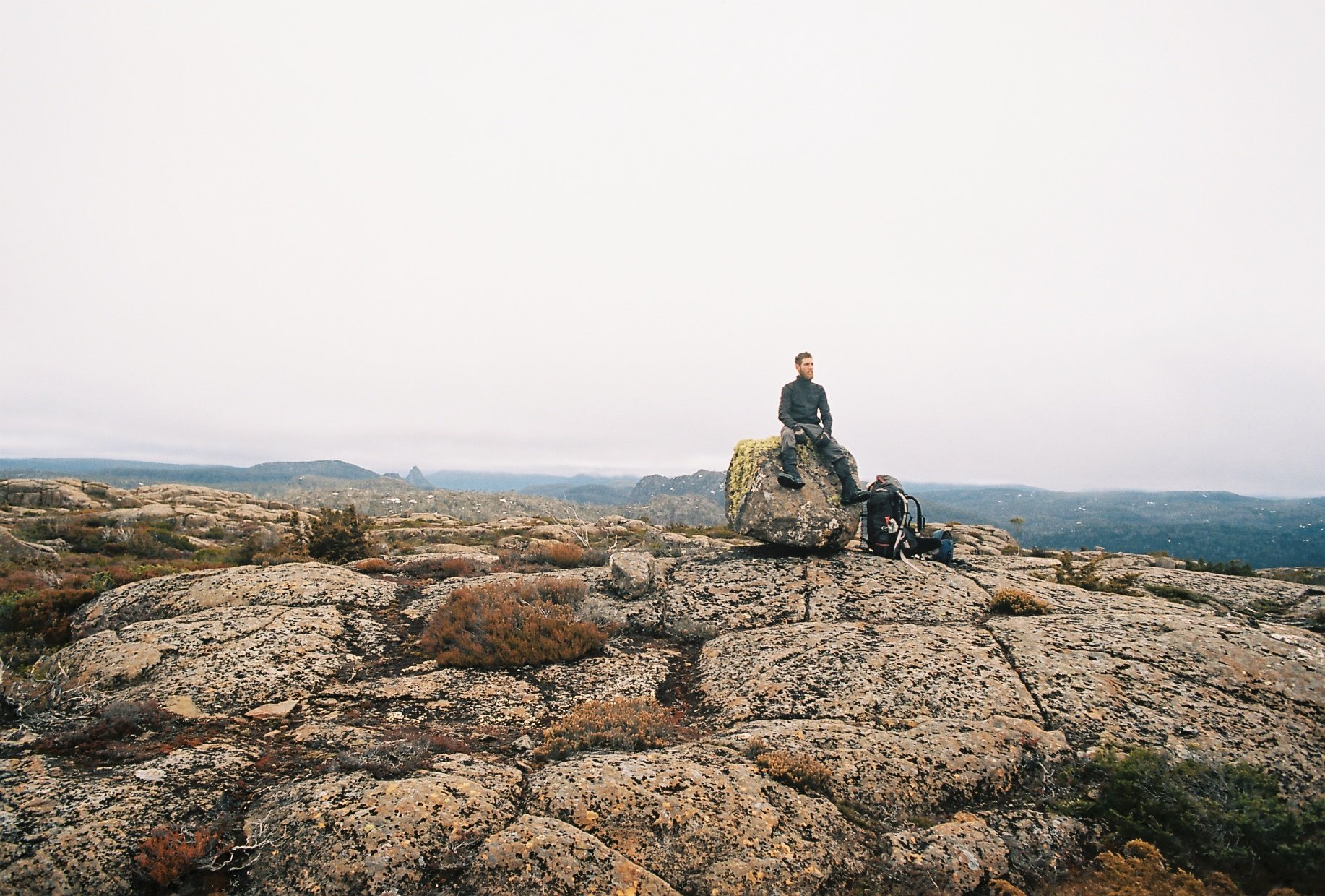
Graveyards and Lullabies

It’s an odd thing, striking out on a long journey. It never feels very real on day one. We plot and plan for so long that when the day finally arrives, it’s never quite as we have imagined it would be.

The touring kit, probably weighed about 40-45kg all up including the bike. Note the cardboard tube attached to the back rack. It contained our rolled up ‘Restore Pedder’ banner. The tube was completely wrapped up with sticky tape in an effort to stop the cardboard from dissolving in the rain.

We departed Hobart early in the morning of Day 1. It was the 16th March, 2022.

I encountered difficulties with my front shifter upon hitting the first climb up to Glenlusk. I eventually figured out that the new waterbottle holder I had put on the previous day was blocking the path of the front gear mechanism and so it couldn’t shift down to granny gear. Once the waterbottle holder was removed, the issue was mainly solved and we were able to continue.

Pat shot out as soon as we hit the incline, and I was left to my own devices, huffing and puffing, wondering if there was anything in my panniers that could have been left at home. Pat waited for me at the top and we took the winding descent to Molesworth. My greatest regret of the trip ended up being: not picking the overladen blackberry bushes along this section of the road!

We stopped at New Norfolk to get some water, then continued along the course of the Derwent River to Gretna, where we read about the life of the bushranger, Martin Cash. Apparently after he broke out from Port Arthur, he ended up at the inn near Gretna, to have a drink but it wasn’t long before the police arrived. After a shootout in which the police were subdued, Martin went back in the pub, finished the bottle of brandy, then left in a hurry.
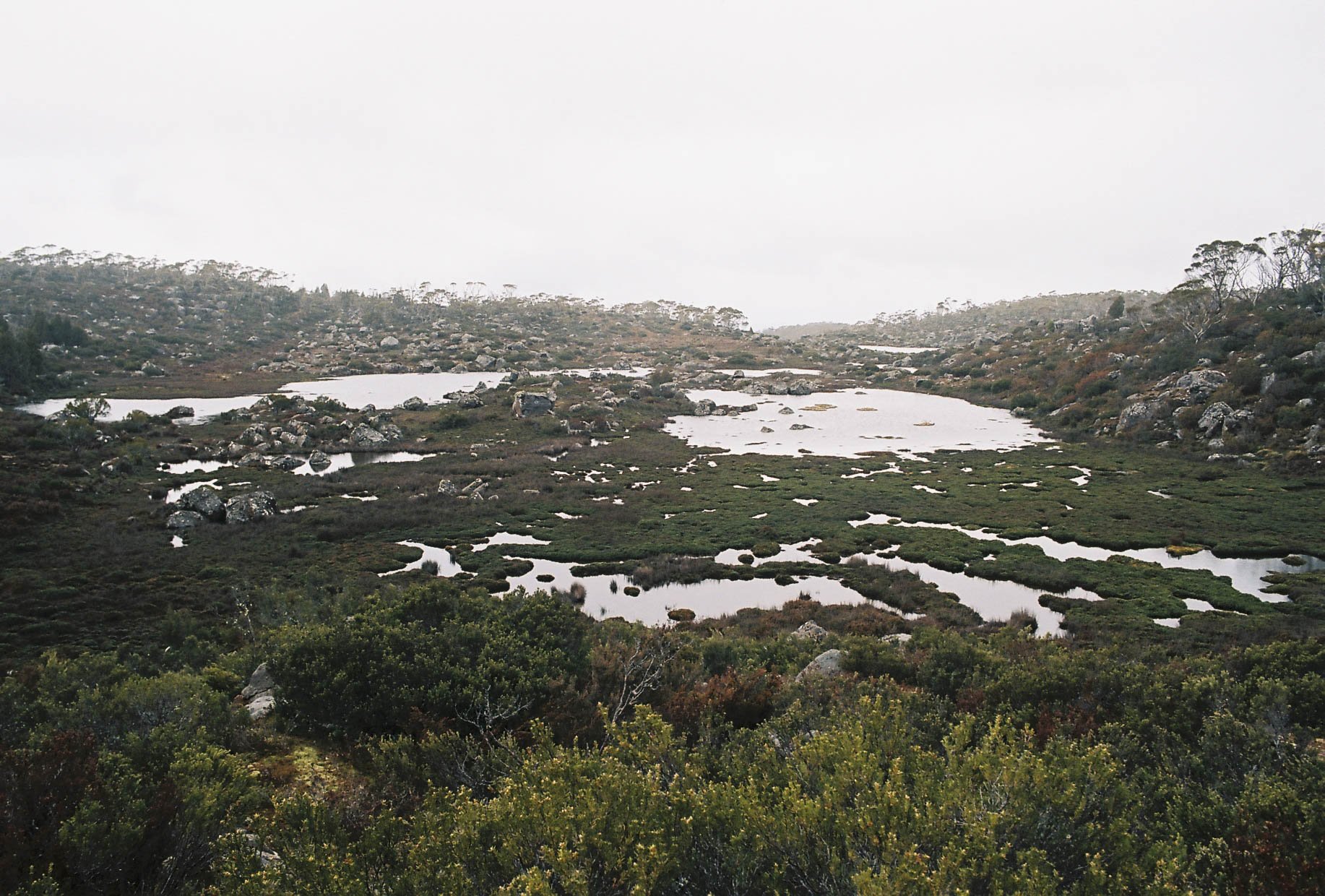
The glaciated nature of the Central Plateau is undeniable. 2019.

The Central Plateau of Tasmania is an enormous highlands region bounded by the Great Western Tiers to the north, Lake Rowallan and Lake St Clair to the west, the Lyell Highway to the south and the Midlands Highway to the east. Looking at a geological map of Tasmania, the Central Plateau is arguably the most obvious geological feature.

I personally think of the Central Plateau as the heart of Tasmania, being central and of an elevated position.

Undulating grazing country, between Hollow Tree and Bothwell.

Approaching the Central Plateau from the south leads one to ride through a dry, undulating country that gradually increases in elevation. There was a remarkable section of sealed road from Hollow Tree to Bothwell. This was an arid landscape of brown farmland, mostly dried out pastures giving home to sheep, except for the greener patches where the giant boomsprays operated. There were quite a few abandoned weatherboard houses, most of them in disrepair, remnant artifacts from the 1800s. One house looked either haunted by ghosts or squatters. In hindsight, I’m not sure which.

When we got to Bothwell, we set up camp at the free caravan park by the graveyard.

The gravestones in Bothwell stood nearly as crooked as the branches of two trees that were peculiarly identical.

Bothwell to Steppe was 34km, a distance which took us four hours to ride the next morning. We must have gained about 700-800m in elevation; the ascent with our load was slow and reasonably grueling. We had our morning break at the historic Steppes Household, home to the constable appointed in the 1860s, a household which eventually turned from outpost to post office. There was a cute A frame hut in the garden, which used to belong to Jack Thwaites. It had a Currawong sympol on it and made me want to spend some time inside but alas it was locked. There was also a great art installation near the homestead by Steven Walker; a circle of 12 stones with metal engravings depicting some local animals and plants.

Tassie Devil by the side of the road, on the way to Miena.

From Steppe to Miena we were battling steady headwinds and we drafted behind each other to ease progress. We had left the sheep paddocks behind and were riding through native sub alpine forest dotted with cidergums and underlaid by pink mountainberries. Wallabies darted among the scrub from time to time as we rode past.

At one point we pulled over to take a break by the side of the road, and I started watering a particularly large eucalypt tree. Suddenly, I found myself leaping into the air uncontrollably! I had been bit on the achilles by a rather grumpy bull ant, who was letting me know that I have stood on their nest. The ground was swarming with inchmen so I decided to finish watering the tree from a different location.

The hut of Jack Thwaites, at the Steppes Homestead near Miena.

We passed the dam on the Great Lake with relief, as this meant we were close to our lunch stop. It was 3pm so it took us about 6 hours to ride 64km. This was slow progress indeed. We had a hot beef-shitake-miso-lunch then cruised on.

The following section took us past the shore of the Great Lake, through undulating forest, and a smattering of shacks along the way. Tin roofs and walls, large windows and a healthy wood stack seemed to be common themes. The bush through here was serene. The wind had calmed and there must have been rain earlier as the road was wet and the air smelt as it does after fresh rain.

The final climb up to the Great Lake Lookout wasn’t as bad as we anticipated. It was funny, I seemed to hit a rhythm on the bike which I felt I could sustain for a long time. But when we finally stopped I felt I couldn’t move.

We set up camp on one of the viewing platforms at Pine Lake, among the Pencil Pines, who gave us shelter from the wind.

The pines played their lullabies, leaves whispering in the wind.

To be continued…

Strange Meetings

A photo essay of sorts… from the Victorian leg of our recent Australian Alps ride.

The eagle, perched high above. Near the top of Mt Dandenong.

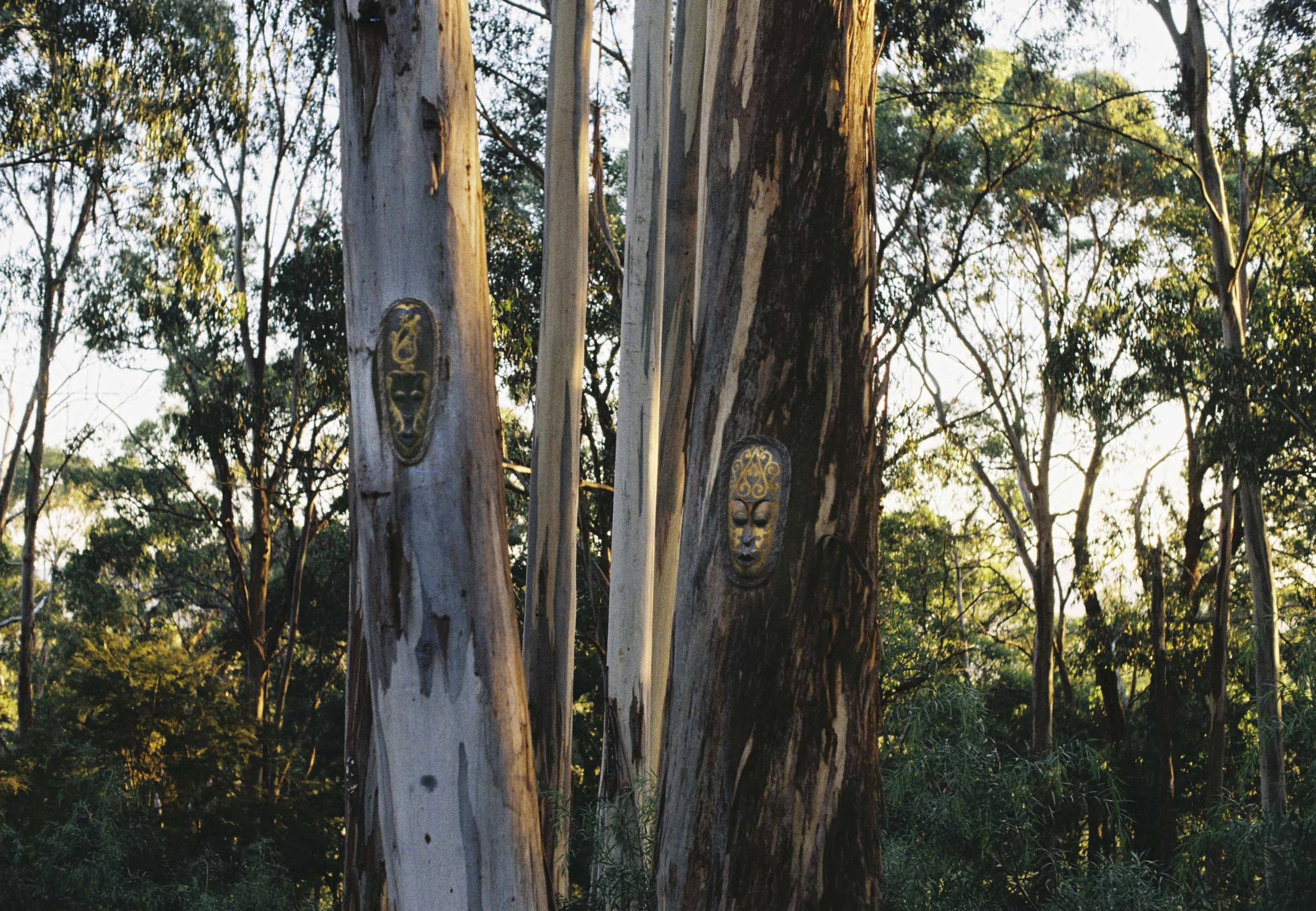
Golden faces in the trees. Forest near Warburton.

The buddha. Sitting still for some time. Not far from the Yarra River.

Sambo, the samber deer. ‘Why am I tied to a tree?’ he says.

Patty K putting the pedal down as we roll across the Yarra Ranges.

Rolling across the Snowy Mountains

The Thredbo River used to be called the Crackenback River. The story went that this was country so steep that it would crack a man’s back if he tried to ride a horse through it.

Pat Kirkby doing his best cowboy pose.

The head of the Crackenback River isn’t far from Mt Kosciouszko. Being the top of Australia, it is fitting that this section of the Great Dividing Range is named the Snowy Mountains. The tallest section of the Snowy Mountains is the Main Range of Mt Kosciouszko and is notorious for the coldest weather and deepest snow in Australia. The scoured alpine plateaus are no place to seek shelter from the wind.

The Alpine Way is a sealed road which connects Kanchoban to Jindabyne and reaches up to 1560m at Dead Horse Gap (the joke is, it was the climb that killed the horse). In sections, tall, orange snow poles mark the edge of the road. If the Alpine Way was not cleared in winter with snow ploughs, no one would be driving on it.

Brumbies abound on the high plains of the Snowy Mountains. There are at least two in this picture. ;)

We recently rode our bicycles from Hobart to Canberra with a good friend of mine, Pat Kirkby. Our journey took us across Tasmania’s Central Plateau, then the Yarra Ranges, the Victorian Alps, then into the Snowy Mountains.  We rode the section from Corryong to Jindabyne in three days, but had a rest day at Tom Groggin due to 40mm of rain, the only day during our 27 day trip where we didn’t ride our bikes at all.

As we rolled into Tom Groggin on day 18 of our trip, I saw a mob of emus close up. As I was riding my bike slowly up a gravel track, the emus kept pace with me walking in front of me. Slowly but surely, I got a bit closer and closer, so I was able to observe their movements for some time. However, there came a decisive moment when I got too close for their comfort and they all bolted. As they ran, they seemed to leave their heads behind while the rest of their body moved forward, a bit like one might expect a cartoon character to behave when startled.

We took our rest day at the lush campsite of Tom Groggin and found that the kangaroos were tame and would come up to us and nudge our hand to give them food. We declined politely. The birds were a bit more cheeky and would steal any food left unattended on our picnic table within seconds. In the end, we spent most of the day inside the tent, listening to sound of rain on the fly. We broke out a pack of cards and played a game called rummy.

The eucalypt forests were lush on the lower slopes of the Snowies.

We struck out the next day to get up the hill to Dead Horse Gap. We were anticipating a steep and grueling climb.The reality did not end up being as difficult as we anticipated, probably because it was day 20 and our bodies were getting pretty conditioned to riding up long steep hills with our fully loaded panniers. We had also figured out that given sufficient snacks, just about any hill becomes possible. Nevertheless, the first pinch of the climb out of Tom Groggin was along a very steep road, perhaps 10 percent gradient for a solid 2-3km. The road was narrow and steep and the traffic included hundreds of motorbikers, camper trailers, semi-trucks but weirdly, no other cycle tourers. Luckily for us, most of the traffic seemed to be heading the other way.

We gained elevation quickly, especially on the first section of the climb as it took us onto the crest of a ridge which continued up to the shoulder of the Rams Head Range. As we climbed, the eucalypt trees got gradually shorter and soon we had climbed into the cloud layer where all was still, damp and cold. The forest around us had been burnt three years ago, and while the damage was extensive, it was also clear that the forest was regenerating, with new seedlings springing up and epicormic growth clearly visible on the trunks of the eucalypts. The mist swirling around us created a haunting atmosphere…

Snowgums burnt in the 2019 fires.

To be continued…

The four directions

If rain doesn’t fall for a long time, we call it a drought.

If rain falls for a long time, we call it a flood.

If there is not enough food, we are having a fast.

If there is too much food, we are having a feast.

If we are too far from the fire, we get cold,

If we are too close to the fire, we get burnt.

If we have enough air, we are breathing,

If we don’t have enough, we are drowning.

-A.S.

South

West

North

East

Was it worth the gambit?

At the end of the trip, I tend to ask:

Was it worth carrying the camera?

Fire scars on top of scrubby ridgeline. 2022, Hasselblad 500C/M, 150mm Carl Zeiss Sonnar 150, Ektar 100.

Of late, I’ve been carrying a medium format film camera on some of my trips. It’s a Swedish camera, made in 1980, a certain Hasselblad 500C/M. It takes very nice photos.

It’s more than 40 years old, and operates impeccably. It has no electronic components, so there is no battery to charge up, or replace. There are twelve shots on a 120mm wide roll of negative film. I tend to shoot one roll of film per trip.

The total weight of the camera kit, including tripod is about 4kgs. So when I head into the hills, and I’m climbing some steep hill with a big pack on, sometimes I wonder about my choice of equipment. Is it really worth carrying all that weight, for 12 shots?

Well, I tend to say to myself that if I take a single good shot, then it was worth carrying the kit. One good shot is all I expect from a trip.

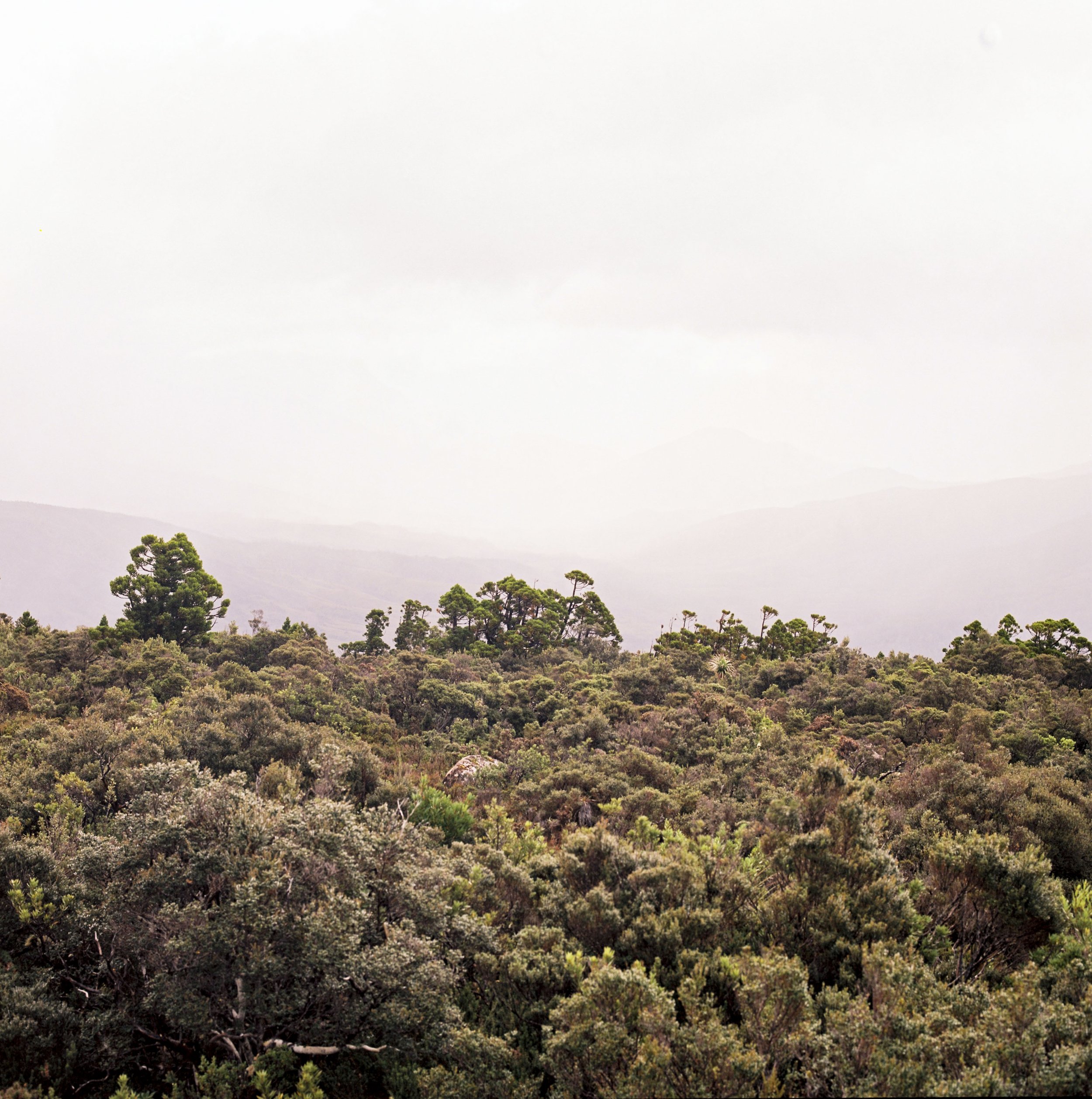
King Billy Pines on scrubby ridgeline. 2022, Hasselblad 500C/M, Carl Zeiss Planar 80, Ektar 100.

It doesn’t always happen, but every now and then, it all lines up and I catch the moment in time.

Herb field, tarns, view toward the crooked spire. 2022, Hasselblad 500 C/M, Carl Zeiss Sonnar 150, Ektar 100.

So, was it worth the gambit?

Into the scrub

“I must not fear. Fear is the mind-killer. Fear is the little death that brings total obliteration. I will face my fear. I will permit it to pass over and through me. And when it has gone past I will turn the eye to see its path. Where the fear has gone there will be nothing. Only I will remain.”

-Frank Herbert, Dune

Behold, the South-West scrub!

I used to be scared of the scrub. I feared to enter it on my own, to leave the path and to immerse myself in it. Part of this was rational fear. What if I never find my way out of here? A legitimate concern. Or, will anyone find me if I fall over and hurt myself and I cannot move? (Probably not.)

And so I worked on the steady step. The step that never falters and never falls, it simply keeps going in the correct direction with steady determination. Eventually, the steady step always arrives to its destination. Although the destination is not always what one expected at the outset.

Fagus, above sub-alpine tarn.

The scrub appears to be our adversary. It makes walking difficult, it blocks our way and it requires a lot of effort. It can be painful, exhausting and frustrating to make way, when there are millions of woody limbs sprawled out in all directions, preventing easy progress. But if we spend enough time in scrub, the battle to make progress becomes a dance, one we get accustomed to, and one whose rule we slowly but surely learn.

I would define scrub as low, dense vegetation. Sometimes it might only be waist height, other times, it could be several meters tall. The floor of a forest may be ‘scrubby’, but that’s not really what I would call scrub.

Some of the thickest scrub in Tassie occurs above the forests, in the sub-alpine regions. When the fagus shows up, the myrtle beech trees become dwarfed, and scoparia appears, we know we have reached the dreaded zone. Between the luscious forests and the scoured alpine plateaus, the sub-alpine band awaits with deviousness.

800-1100m in elevation is the Tasmanian ‘death-zone’.

As a friend of mine recently pointed out, ‘The thing about this scrub is that it doesn’t really bend and it doesn’t really break.’ Therefore, progress is rather difficult. In order to get through, one must contort one’s body, and wriggle when stuck. Brute force is pretty much useless as a long term survival strategy. It mainly just wears a person out. Although sometimes, it is required. Especially through bauerea. But steady progress in scrub can only be made by acting like a quoll or a wombat. We must become either very nimble, agile and flexible, or we must get low down to the ground, dig in our teeth, and make a tunnel.

The use of a machette would not only be disrespectful to these hardy sub alpine plants, it would also be mostly useless. More energy would be expended in hacking through thick woody limbs than the amount of effort required to pass through, perhaps snap a few branches by accident and leave a barely noticeable line of weakness.

The best thing about scrub is that at some point, we get out of it.

Bushwalkers tend to funnel into natural bottlenecks on popular walking routes, creating these lines of weakness in the scrub, for subsequent parties to follow. The sad part is, eventually most of these lines of weakness become well worn pads, and some of those pads become well trafficked walkways that offer no resemblance to the original experience. Safe passage becomes matter of fact when there is a clear cut track.

Safe passage through scrub is never guaranteed. Skewered eye balls, broken ribs, heat exhaustion, dehydration, are all very real risks when one spends extended periods of time in the scrub. Progress is painstakingly slow, in some places as little as 1-2km a day, and that’s only through severe effort.

Let the scrub be the scrub. Don’t try to thin it out, order it, tame it, cut it or get rid of it.

Take it or leave it. Just don’t bash it.

Double Exposures

“Just because our efforts are futile, it doesn’t mean they are meaningless.” -A.S.

A sinkhole and a distant ridgeline. 2020, Hasselblad 500C/M, Carl Zeiss Planar 70mm. Ektar 100.

A double exposure happens when the film inside a camera gets exposed to light on two separate occasions, creating two overlapping images on the same piece of film.

In my experience, most of my double exposures have occurred on my Hasselblad 500C/M, and none of them were intended. Since it’s a modular camera, it is possible to wind the shutter up while the film canister is detached. Therefore, it is possible to take a photograph without forwarding the film. Since both photographs are moulded together, it means we didn’t capture the single subject we intended each time. It’s easy to be disappointed, and to feel that both photographs were taken in futility.

King Billy forest and glacial lake. Hasselblad 500C/M, Carl Zeiss Planar 70mm.

But double exposures have their own value and not only because they can help us learn how to use our camera properly.

The result of a double exposure can be a much more interesting image than what we originally intended.

Van on Bruny, tree trunk. Hasselblad 500C/M, Carl Zeiss Planar 70mm.

Raison d'etre

Stand on a mountain

Breathe in as the wild winds blow

Dissolve your shadow.

Curled pandanni leaves

That withstood a thousand storms

Rustle in the wind.

Relinquish the Earth,

Free her from your desire

She will nourish you.

The great mystery

Time, an elastic string

What to do with it?

Old man to the wind

If forest is a city

Mountain is a shrine.

Roaming

There comes a time, when the time comes to get away.

Which way will you go?

Right is wrong and wrong is right

Just follow your heart.

Become lost, then found

It’s coldest just before dawn,

Then the sun rises.

Wind sways through the trees

Dances past the trunks with ease

Rustles fallen leaves.