Tales of ents and elves...

“It's a dangerous business, Frodo, going out your door. You step onto the road, and if you don't keep your feet, there's no knowing where you might be swept off to.”

-Bilbo Baggins from The Lord of the Rings by J.R.R. Tolkiens.

Not exactly a plantation.

There are certain places where we will only ever be visitors.

Deep in the temperate rainforests of Tasmania, it is moist, gloomy and generally cool. The soil smells of decomposing organic matter, and the ground is coated in moss and lichen. This is the prehistoric world of plants; and animal life is rare. Occasionally, a bird will call, but mostly there is silence, except for the whispering leaves in the wind. Warm blooded creatures tend to hang out somewhere else.

Handsome fungi.

This is the world of plants and fungi. When the plants die, when the trees fall down, the intricate network of fungi within the soil go to work, break down the timber, and make these nutrients available for other trees and plants to take up again. And when these fungi are ready to reproduce, we see the mushrooms pop up. But these are only a small part of a much larger organism hidden beneath the ground. The fine filaments of the fungi, or mycelium networks are so numerous that there can be kilometres of these filaments beneath a single footstep.

Two frozen ents, captured in time.

The ents in Tolkiens’ world were the tree protectors, the guardians. They were quite like trees themselves, except they could move. They would talk in really long sentences, because they have seen a lot and they had plenty of time.

I feel that we need more ents in our current time. We need beings who move slow and talk slow, and look out for the trees’ well being. We need elves too, the companions to the human race, except fairer, wiser and with eternal lives. Creatures whose wisdom exceeds ours, and creatures that we could look to, in order to help our own disheveled lives.

Where else would the elves live, but here, among the oldest trees? I haven’t found them yet, but this doesn’t mean that I will stop looking.

A.S. 10/3/22, Lenah Valley.

Fractals in the rainforest.

What was once, will be again

“If we can build a dam, we can also pull it down.” -Andy Szollosi

This image consists of two photographs. One was taken by Lindsay Hope in 1972, as Lake Pedder was about to be flooded, and the other one in 2021 by Andy Szollosi. The two images have the same composition, and are superimposed to create a single image, showing the shoreline of the original Lake Pedder, with its quartzite beach, but also the shoreline of the current impoundment. This edit was created by Andy Szollosi, with some valuable help from Matt Jones.

Media Release

Andy Szollosi and Pat Kirkby are set to ride their bikes from Hobart to Canberra in March-April 2022, to take a message from the home of the Restore Pedder movement to Parliment House. They are going to call on all politicians and political parties to commit to the restoration of Lake Pedder in the lead up to this year's Federal Election.

"The UN has called for this decade to be one of ecological restoration. What better way for Tasmanians to partake in this than to restore the beating heart of the Southwest?” –Andy Szollosi said.

"I’m pedaling for Pedder because I believe the restoration of this iconic wilderness area could show the world that we can go beyond just trying to slow the rate of ecosystem degradation. The restoration of Lake Pedder could be a globally iconic project that would provide hope for humanity, in this age of global environmental collapse." -Pat Kirkby said.

Pat and Andy will ride their pushbikes self sufficiently, without support, across Australia's tallest mountains, The Great Dividing Range. Along the way they hope to raise awareness and funds for the Restore Pedder movement. It's a journey that they expect will take them four weeks to complete.

People who wish to donate to their cause can do so through Pat and Andy’s Gofundme page.

When the billy breaks

Adventure begins when things don’t go to plan.

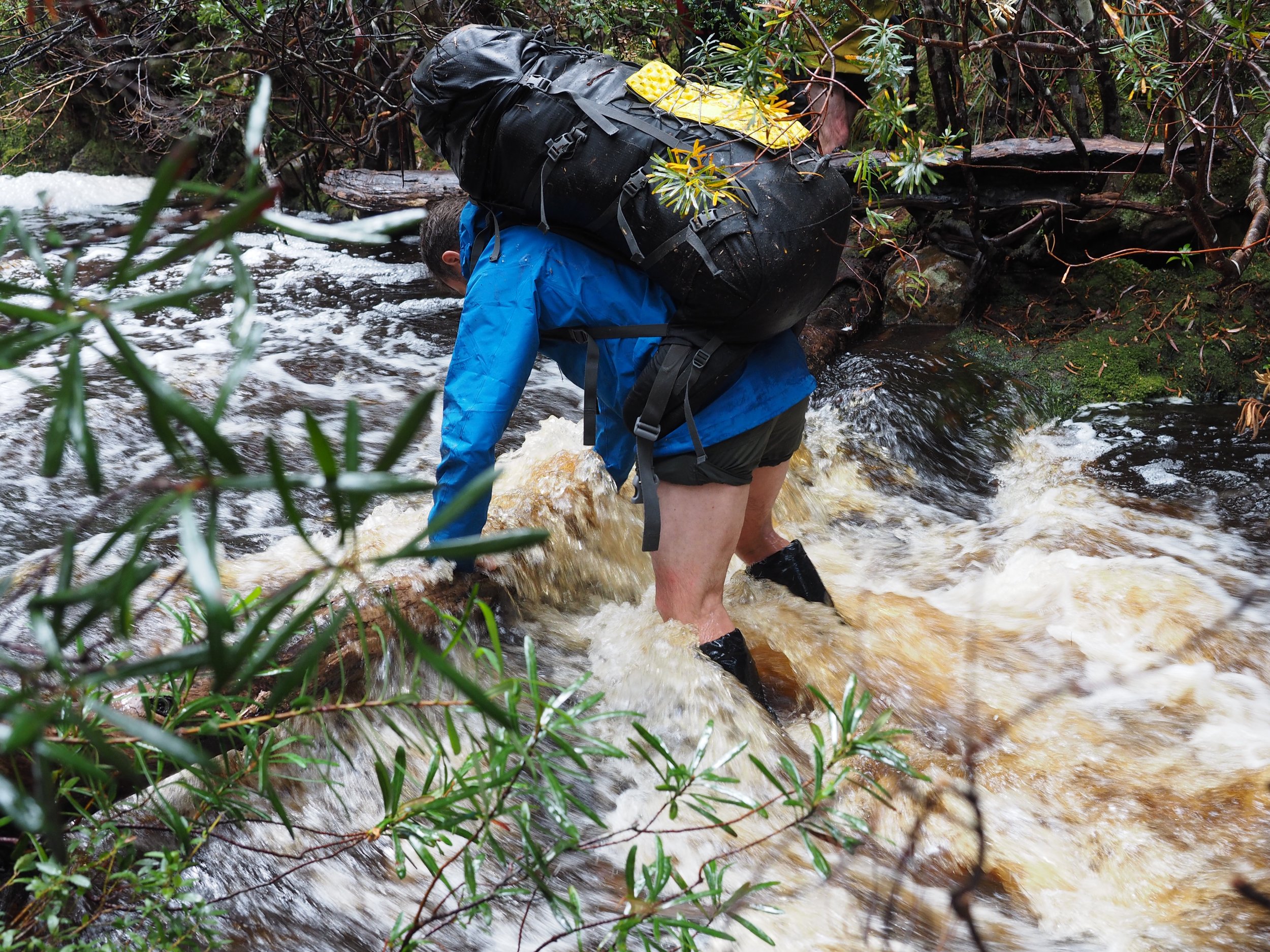
Correct creek crossing technique, as demonstrated by the inimitable Stu Bowling.

The first principle of the ‘leave no trace’ code is to ‘plan ahead and prepare’. There are multitudes of good reasons for this. Planning minimizes the likelihood of us coming undone in the bush. Having a plan means we will have enough food to eat, enough water to drink, and ideally end up where we intend to go. If we can boil our billy and have a cup of tea, as per the plan, that is great. However, none of my most memorable trips ended up going exactly to plan. Sometimes, the billy breaks, and hot water goes everywhere.

Now I don’t particularly enjoy hot water spilling unexpectedly from a heated vessel. Especially if I’m in its close proximity. But those times when the metaphorical billy did break and I was left with a troublesome situation, those times resulted in the greatest personal growth, or the building of the ever so elusive ‘character’.

‘Are you sure this is the way Andy?’ -Daniel Panek.

Building character is about surprising ourselves, and undertaking actions we didn’t think we were capable of doing. A lot of the time, we don’t know whether we can do something, and we simply tell ourselves that we can’t. ‘You’ll get hurt’. This voice is worth hearing out, but if we give in to it we won’t grow at all. We need to make mistakes in order to truly learn something. When we really screw up, this gives us the greatest opportunity to learn.

During a difficult trip, we tend to arrive to crux points, or natural bottlenecks, through which we must funnel through, in order to get out of the bottle and reach our destination. It can be dictated by the landscape, by the weather, by our own skill, preparation or equipment list. When we arrive to a bottleneck, the available options to us narrow down. Life becomes very simple, but rather difficult.

Arriving to a natural bottleneck, or a ‘crux’ of our trip could mean we have run out of food many days from the end of our trip, or that the sole of our boots have fallen off, or that we are unable to arrive to a decision with our adventure buddy about something important. It might mean we have become lost, we don’t have enough water, or that we are injured, and unable to move without pain. Having to funnel through a bottleneck might mean having to cross a river, or going across a high pass in a mountain range, or it might mean wriggling our way through a particularly dense thicket of vegetation.

The west coast rocks are not kind to rubber and leather.

There does not exist a definitive guide on how to deal with a crux situation. If someone claims to have written one I wouldn’t trust it. Every situation is different, and hides a subtly different solution.

In trying to find a solution, what will help us is if we are able to focus our awareness on the problem. But there is more to solving a problem than simply paying attention. We must listen with our entire being and react to the challenges presented to us with calculated precision and determination. And sometimes, a bit of brute force and stamina might help as well.

Generally, we are given an opportunity to extract ourselves out of a pickle before we turn to vinegar in our metaphorical bottle. If we continue making bad decisions that are based on our lack of paying attention to our environment, and the dynamic nature of its change, then we will continue to remain in the pickling jar. To find our way out of a tricky situation, concentration is required. What we need is an application of our attention to come up with a creative solution.

A crux sequence will present us with a problem which we don’t really know how to solve. But we have to solve it anyway. We may not be ready, we may not even be willing, but a true adventure will force us to solve a problem we didn’t know we were capable of solving.

The realisation that we are capable of much more than what we thought was possible is the sign that not everything went to plan. When the billy breaks, we have an opportunity to become much more than we were.

My personal rule is that if I can make a cup of tea out in the bush, then everything is fine. Making a cup of tea implies access to water, shelter, and some way of keeping warm. So if I can boil a billy, everything will be just fine.

But I would be truly disappointed if every trip I took included a hot cup of tea at the end of each day. Sometimes the billy needs to break, and hot water must go everywhere.

Pretty sure the wicked witch of the west lives out here somewhere.

PS: I renamed my blog this week to ‘The Boiling Billy’. There was a facebook page called ‘Mountains of Tasmania’ so I wanted to avoid confusion in the long term. If you haven’t signed up to these weekly posts to be sent direct to your inbox, here is your chance!

Poems from 'Another Journal of Chaotic Ideas'

Between the lines

The night sleeps like she’s always had

On my pillow I lay my weary head,

Open eyes to galaxies and dreams

A world fueled by love, a world in which I’m at ease.

Basic goodness is our right

Children of the universe

We skip pebbles on the ocean’s shore,

Living lost memories

Our name is riding on the wind, it calls.

How far down life’s highway

Are you willing to place the bet?

The traffic crawls to a stop,

Two lanes on the bridge become a jam.

Loving lost memories

We turn the book,

Gaze upon the page;

Recall a memory vague.

We promise and we collect

Give, take, give, take, take, take.

A scale tipped out of balance,

There’s only one way to dance.

Close your eyes,

But keep watch on the page,

Every secret ever told

is staring you in the face.

Your skin tingles,

Your dream delights,

One hope, one dream,

Within you is the light.

A.S. 14/1/2015

Henry’s Prophecy

I put my head under

Only for a second

and now, everywhere

I turn my head


All I see is blue, dark, red;

Three principal colours,

One right, one left.

The fish are swimming

Around and around my head

My hands are cold

My feet are wet.

Perhaps it’s time

To listen to Henry the octopus,

He can tell the future, you know.

I asked him once

What would happen to me

He just shook his head

He told me this story instead.

“Once there was a world

So blue it was red,

The sun rose so bright,

That night was black.”

A.S. Oct 2015.

How not to sink

Keep things simple. Elegance lies in economy.

Waste not the precious gifts of youth

Use not the endless chains,

Unforgiving loops of thought

That always bring you back

To the same milestone

You have left behind.

Be not too greedy,

Take satisfaction in matters

As they stand,

Yet hold your vision steady.

Get ready to launch your raft

When the boat begins to sail,

A life jacket has never saved a single life

Except of those who have worn it.

The Titanic sunk for a simple reason,

It was never built to sail,

Instead she was to leap between the continents

Carrying the world’s wealth with ease;

Some ideas are set to fail.

In her confidence

It all came crashing down,

Iceberg, momentum

Scrape, leak, icy water.

May they rest beneath the waves.

A.S. 2/11/15

A Liberal Decalogue

by Bertrand Russell.

  1. “Do not feel absolutely certain of anything.

  2. Do not think it worthwhile to proceed by concealing evidence, for the evidence is sure to come to light.

  3. Never try to discourage thinking, for you are sure to succeed.

  4. Overcome arguments by arguments, not authority, for a victory dependent on authority is unreal and illusory.

  5. Have no respect for the authority of others, for there are always contrary authorities to be found.

  6. Do not use power to suppress opinions you think pernicious, for if you do, the opinions will suppress you.

  7. Do not fear to be eccentric in opinion, for every opinion now accepted was once eccentric.

  8. Find more pleasure in intelligent dissent than in passive agreement, for, if you value intelligence as you should, the former implies a deeper agreement than the latter.

  9. Be scrupulously truthful, even if the truth is inconvenient, for it is more inconvenient when you try to conceal it.

  10. Do not feel envious of the happiness of those who live in a fool’s paradise, for only a fool would think that it is happiness. “

And that's the way the billy boils...

Bushwalkers’ attitudes are rapidly changing around the globe.

Tha classic Tasmanian bushwalker’s ‘look’. Canvas pack and gaiters, broad rimmed hat, sturdy pants for the scrub and a long sleeved collared shirt to protect from the harsh rays of the sun. The only thing that’s missing in this picture are the scrub gloves (gardening gloves) to protect against all the prickles. These days, I no longer wear a watch and have replaced my waxed cotton hat with a daggy legionaries hat that has been described as ‘wearing old man’s undies on my head’. ‘Look’ is irrelevant in the bush, what matters is functionality.

Bushwalkers’ attitude is changing rapidly, and with it, the gear that is being manufactured globally. Outdoor clothing and equipment these days isn’t simply expected to perform, it’s also expected to sell. And if gear is to sell, it needs to appeal to the user. Some outdoor clothing brands sell well because the user feels empowered while wearing their products. One brand in particular makes gear and clothing that is functional but also looks neat. And despite the fact that this brand isn’t known for their product’s durability, and despite the fact that their products are overpriced, people still buy it. (In certain parts of the world, wearing certain brands can be seen as a statement of social status). A fancy raincoat might only keep you half dry, but at least you will look your best while you gradually get soaked.

I’m sad to say that it seems to me that disappearing are the days of the ‘daggy’ bushwalker trudging through the mud just for the fun of it, replaced by the trendy and instagram savvy hiker with their fresh clean look and brand new beautifully beading jacket, wearing waterproof boots while walking on a pounded dry track without a single puddle on it. Gone are the days of sitting by a fire, waiting patiently for one’s billy to boil. People want hot water and they want it now! So they blast out their gas canisters, and sip their tea while it’s still too hot and often burn themselves by using lightweight titanium cups that transmit the heat really efficiently to one’s sensitive lips.

My favourite cup is a red and white enamel cup I bought in Hungary about six years ago. It’s not exactly lightweight, and has a handle that sticks out. But it reminds me of home and I tend to take it with me. Not every time, but whenever I can.

The tradition of bushwalking as a modern recreational activity is seeped in the appreciation of Nature. It is about having a slow cup of tea and taking in your surroundings. It’s about learning bird calls, recognising certain creatures and features of the land and getting to know them. It’s about noticing a three hundred million year fossil, embedded in rock as one steps over it. It’s about returning to a place over and over again, in order to perceive how it changes over long periods of time. It annoys me when people describe a visit to a place as having ‘done it’. Have you learnt everything you can about a place from a single visit? Has the landscape given you everything it may provide for you?

Bushwalking is also driven by challenge and exploration as manifested in one of my least favourite terms of the English language. ‘Bush-bashing’. People use this phrase so casually, and frequently. It portrays the attitude of the bushwalker being an adversary of the environment they visit. I prefer to say ‘scrub wriggling’, to imply one must find a playful path through the vegetation, rather than create a passage of destruction through the use of brute force. Language is a powerful tool, and it shapes us as much as we shape it. Just because a term rolls of the tongue easily doesn’t mean we should use it mindlessly.

Appreciating a west coast sunset.

There is a curiosity that draws people out to the Tasmanian bush. And it’s probably not curiosity about the scrub, the mud or the snakes for most people. But the scrub and the mud and the snakes are all part of it. The walker must give some kind of effort, in order to reach a place that is worth visiting. The greater the effort the walker is willing to put in, the greater the reward that may be gained from visiting the place.

The place that the walker visits alters the walker’s nature. This is why experienced Tasmanian walkers tend to be wiry, stubborn, and overly optimistic. These are the traits that are required to reach certain parts of Tasmania on foot. Each trip that a buhwalker undertakes alters their nature; increases their stamina, resilience and knowledge of the landscape.

We enter the bush, the wild, because we are curious, because we wish to see what is out there. And when we enter nature, we interact with it, we leave a mark, leave some kind of effect. For old time bushwalkers it was fine to strip pandani leaves to kindle a fire. It was fine to cut new tracks, to create new campsites. It was fine to air drop food to remote places, and to leave the buckets out there and simply bury any rubbish one had. The bush seemed infinite, and endless. That is no longer the case.

These days bushwalkers follow Leave No Trace principles. Plan ahead and prepare. Travel and camp on hard and durable surfaces. Dispose of waste properly. Leave what you find. Minimise campfire impacts. Respect wildlife. Be considerate of others.

As the number of people increases on this globe, and the size of our wild areas decreases, the demand placed on these remaining areas continues to grow. The more native habitat we wipe out, the more valuable the remainder becomes. And the more people will wish to spend time in it.

In the last hundred years, bushwalkers’ attitudes have shifted from those of conquerors, to visitors.

And now, we must evolve from visitors to custodians.

It is no longer enough to preserve. We must also begin to restore.

-A.S. Lenah Valley. 11/02/22

8 days worth of yabby juice

The highland yabby is about as elusive as the ghost of a yeti.

There is an unlikely creature that lives in the buttongrass moorlands of sub alpine Tasmania. The highland yabby, or burrowing crayfish, digs holes in the soil which fill up with water, and they live within these holes most of their lives. I’m not sure how far down their holes may reach into the ground, but I imagine there to be more of a horizontal maze rather than a vertical one, as their habitat is often underlaid by extensive rock shelves. Nevertheless, some of these yabby hole systems, often high up on ridgelines, can be extensive. Yabbies tend to come out of their holes upon heavy rains and scavange around for rotting plants among other things…

You’d think that living life as a yabby in a wet hole somewhere high up in the mountains on some gnarly old ridgeline would be somewhat peaceful and serene. Surely those yabbies wouldn’t have much to worry about?

Well, someone told me once that the big yabbies eat the smaller yabbies and so that sometimes, you can get these giant yabby queens and kings, living in their underwater warrens, who reign supreme for a while, until some bigger yabbies comes along.

I don’t know if I want to believe that story completely. It can’t be all about survival. Surely the yabbies have some catch ups that don’t involve eating each other? It really can’t be such a bad life.

Unless of course, the wet hole turns into a dry hole. If it doesn’t rain, the ridgelines are the first to dry out. They are exposed to the wind and the water runs off, to lower places. Without water, the yabbies dry up as well. They need water in their little holes to survive. So if their holes dry up they would only have one option. They would have to undertake a journey down the hill, towards more plentiful ground water, but this is bound to be hazardous and fraught with many dangers.

In the eight years that I have lived in Tasmania, I have only seen these bluish creatures once or twice. I have walked past thousands of their homes, those little holes in the ground about one inch in diameter. And in the eight days that I spent on the range depicted in these photos, I drank only the water that I managed to siphon out of the ground using my yabby tube. I remember the water tasting a bit shrimpy on some of the days, and it gave me some strange hand tremors a couple of times, but I never got sick from it. Luckily for the yabbies, the surrounding groundwater means that their holes fill up with water very shortly after they are drained by cheeky bushwalkers.

Long live the highland yabbies!

-A.S. 5/2/22, Lenah Valley.

Recognition Day

There is a cultural shift taking place in Australia, which began in the 1960s, when First Nations people were first recognised as human beings by the law.

If we wish to live in harmony with the people who have been on this continent for much longer than us western settlers, we must recognise that this land was never ceded by its original inhabitants. This land was taken by force, and we still celebrate the day the First Fleet arrived from England as ‘Australia Day’. If we wish to have a national holiday that all Australians can celebrate, perhaps we should pick a date that doesn’t signify the day which began the demise of the culture of the original inhabitants of this land.

I liked Bob Brown’s suggestion recently to keep the 26th January as a public holiday but to call it Recognition Day instead. This goes to the heart of what First Nations people have been asking for generations. Acknowledgement of what happened, although this will not be enough. It’s not enough to listen. We must also alter our attitude toward the land which now gives home to all of us.

If we wish to have a national day that we can all celebrate, let’s make it a neutral day, one that doesn’t evoke pain for the people who have lived here the longest. And let’s actually listen to what First Nations people have to say, to what they have to teach us. If they say that land is sacred and that we must not cut another coal mine out of the Earth, let’s heed that advice. There are more important things in this world than the economy. There is at least 40 000 years of lessons that remain in the culture of our Indigenous people. We can ignore their requests and their advice only at our own peril.

To commemorate Recognition Day this year, I will share with you some of my notes I jotted down in my journal last year upon reading an essay by Wendell Berry titled ‘A native hill’, written in 1968. His view of the land brings to mind the attitude of native people around the world. In particular, I like his comparison of a path to that of a road.

A.S. -26.1.2022, Lenah Valley

From 'A Native Hill (1968)' by Wendell Berry

“I am forced, against all my hopes and inclinations, to regard the history of my people here as the progress of doom of what I value most in the world: the life and health of the Earth, the peacefulness of human communities and households.”

“The idea was that when faced with abundance, one should consume abundantly, an idea that has survived to become the basis of our present economy.”

“A path is little more than habit that comes with knowledge of a place… It is not destructive. It is the perfect adaptation, through experience and familiarity…

A road on the other hand, embodies a resistance against the landscape… Its wish is to avoid contact with the landscape… its tendency is to translate place into space in order to traverse it with the least effort.”

“The thought of what was here once and is gone forever will not leave me as long as I live. It is as though I walk knee-deep in its absence”.

“I do not doubt that it is only on the condition of humility and reverence before the world that our species will be able to remain in it. “

“Until we understand what the land is, we are at odds with everything we touch.”

“I have thrown away my lantern and I can see the dark.”

“It is not from ourselves that we will learn to be better than we are.”

The wandering muse

“If we want to change the world we have to begin by changing ourselves.” -Dalai Lama

The donkey and the dogs

There is this donkey

That lives in the valley

And every morning

It lets out a call.

It is a loud, fearsome sound,

and it echoes through the valley;

It leaves no doubt that

This donkey is kicking and alive.

The dogs in the valley

Await the donkey’s morning call

and upon hearing it

They join in with elongated howls.

This I call the Brushy Creek Chorus,

and it gives me heart,

For it tells me I am not

The only animal that needs to howl.

A.S. Lenah Valley, 31.5.21

Dog walking a man

I saw the perfect case of a dog

Walking a man this morning.

It was a solid bull dog,

Pulling a chubby, middle aged man

By the leash, and while

The man held the upper hand

It was clear that the dog was

Leading the way.

I thought it was funny, you know,

When owners think they are

Going to walk their pets,

The pets probably think they

Are out to walk their owners.

A.S. Soho 16.4.20.

Glorious Rest

When your fuel tank is empty

and you’ve got nowhere to go

There is one place left always,

Remain where you find yourself to be.

The fallen leaf, drifting on a river

Lets itself be carried, is one with the flow,

It has nowhere else it would rather go

Than to meander on, from source to sea.

When you have worn yourself out

And you have a thousand tasks ahead

Sometimes it is worth admitting

That today is a glorious day of rest.

A.S. Lenah Valley. 27.09.2021

Fruition

A thought arrives

Snippet from a dream

It comes to us on gentle wings

Offers to help us carry that load.


Where will we go

Now that we can fly?

What are boundaries

When we can cross the sky?

Our bodies are the dust of stars

Our spirit is the yearning to be one

Like we were,

Before it all began.

A.S. Lenah Valley, 18.8.2021

The gorilla in the room

Are you sufficiently distracted yet?

When I was studying science at university, I took a class in first year called history and philosophy of science, taught by Dr Neil Thomason. One day our professor showed us a video in our lecture. The video had a handful of people standing in a circle, passing a ball between them in a room. He told us that it is really important that we count how many times the ball gets passed from person to person. So when he hit play, we all watched intently, focused on the ball and counted the number of passes. At the end of the video, we compared our answers. Most people had the correct number, with some variations, as to be expected. But then, Dr Thomason asked us a peculiar question.

“How many of you saw the gorilla walking across the room?” Most of the lecture hall was confounded. Some people laughed. To explain, he simply asked us to watch the video a second time, without counting the number of ball passes. This time, we all saw the person dressed in a gorilla suit, stroll through the centre of the circle. We saw it, because we weren’t so focused on the ball. Previously, we were oblivious to the gorilla’s presence. Dr Thomason taught us that if you make people focus on one thing with great intensity, they become blind to other things that happen around them, things that they would normally notice.

Focus is generally defined as undivided attention on a particular subject. The reverse definition of this could be to say that focus is deliberate blindness to everything except one subject. In order to focus on one thing, we must neglect all other things. So whatever it is we focus on, we can’t focus on anything else. Seems like an obtuse point, I know, and rather obvious. But it has some implications which aren’t often considered.  

The best way to illustrate my point is through example.

Take the news that we receive, digest and consume every day. We listen to the radio, we watch the telly, we read online articles, we watch some videos online, and some of us might even read the newspaper still. Before the covid pandemic began, the news we received was from around the world, and from a reasonably wide variety of topics. Every now and then, there would be a news story that took over the airwaves and it would hog up the  headlines for a few days. Then something else would happen and the headlines would change.  

Since the covid pandemic has begun, our headlines have been dominated by it, not for a few days here and there, but constantly. Perhaps this is fair, as there has been a lot of deaths.

 Australia fared better than a lot of other countries, due to our oversized moat, and our reasonably low population density. We have had 1.61 million recorded cases of Covid and 2621 deaths. This equals a 0.2% mortality rate overall. This means that one in five hundred people who contract Covid die from it. In other countries, the mortality rate has been as high as 7% (Mexico). We need to acknowledge coronavirus as a worthy foe and do our best to protect the vulnerable and minimise the transmission of this virus among ourselves. So yes, the pandemic is newsworthy.

 Nevertheless, think of all the various headlines that covid has usurped from the previous two years. If this virus didn’t exist, all the attention we have given to dealing with this pandemic would have been focused elsewhere. Onto other things. So, what headlines would I have read if the pandemic never happened? Because I have focused on taking in the public health recommendations, and checking the daily case numbers, and all the stories related to covid, what have I failed to make myself aware of? When the media outlets selected covid story after covid story, what is it that they’ve neglected to tell us? What other news would we have heard, if the pandemic never happened?

 These questions are worth pondering, because the stories we are told become our reality. If we are told that we must do X and Y (social distancing and vaccinations) to be safe, and we are told by a source that we trust, then we will believe the message and act accordingly. And while we are listening to our trusted source, we fail to listen to any messages that may come from elsewhere, which may or may not be trustworthy. This other source may be telling us that we need to do A and B (appropriate rest and nutrition) in order to deal with the pandemic. It may not be mutually exclusive to the X and Y (socially distance and get vaccinated) which we hear through more conventional channels, but A and B will go unheeded because for some reason these messages did not end up in the headlines. So X and Y become our stories, our reality, and A and B are neglected and seen as irrelevant to dealing with the pandemic.

This means that the worldview that we have built and which we currently hold valid is incomplete and highly subjective. Nevertheless, our opinions and our views become our convictions and we cling to them desperately. Once established, we protect our views and we ostracise those who oppose them. Despite Australia having reached a 95% vaccination rate (of those who are eligible, not total population), people are being let go of their jobs around the country for refusing to be vaccinated. It started with the health care workers, now hospitality workers and even retail staff face a similar dilemma.

 How long before people need to be vaccinated if they want to enter a supermarket?

We were meant to have herd immunity when we reached 80%. We have reached that now, with more than 80% of our population aged five and over having received two doses of the vaccine. And still, even those few who haven’t been vaccinated may have to choose between their livelihood and injecting a substance into their body whose effects are not fully understood.

There was a recent study that showed that women’s menstrual cycle became longer by a day after receiving their covid vaccinations. While this effect was temporary, it goes to show that the vaccine which is meant to be harmless is likely to have unknown effects.  

We have become transfixed on hand sanitising, social distancing, isolating, contact tracing, mask wearing and above all, vaccinations. These things contain the spread of this virus temporarily, I acknowledge that. Furthermore, these measures have meant that the cases of severe illness are reduced to a manageable quantity, at least so far. But let’s dig a bit deeper here.  

These measures are the things that we have done because we were told to do them by a source that we trust. The World Health Organisation has made these recommendations. That’s why we follow them. We believe it is in our best interest to do so.

And somehow, through all these measures, we have come to count the numbers. Numbers that have come to dominate our lives. We count the infections, the deaths, the recoveries. Our attention is upon the numbers. We are waiting, we are watching and we are counting. Always counting.

  Counting the numbers during this pandemic seems to me just like when we university students counted the number of ball passes in Dr Thomason’s lecture. We thought we were being so clever, getting all the numbers right. And while we were doing that, we missed the obvious. We did not see the gorilla in the room.

If you enjoyed this week’s Mountains of Tasmania post, please consider subscribing and forward this article to a friend.

Thank you. - A.S.