Strange Meetings

A photo essay of sorts… from the Victorian leg of our recent Australian Alps ride.

The eagle, perched high above. Near the top of Mt Dandenong.

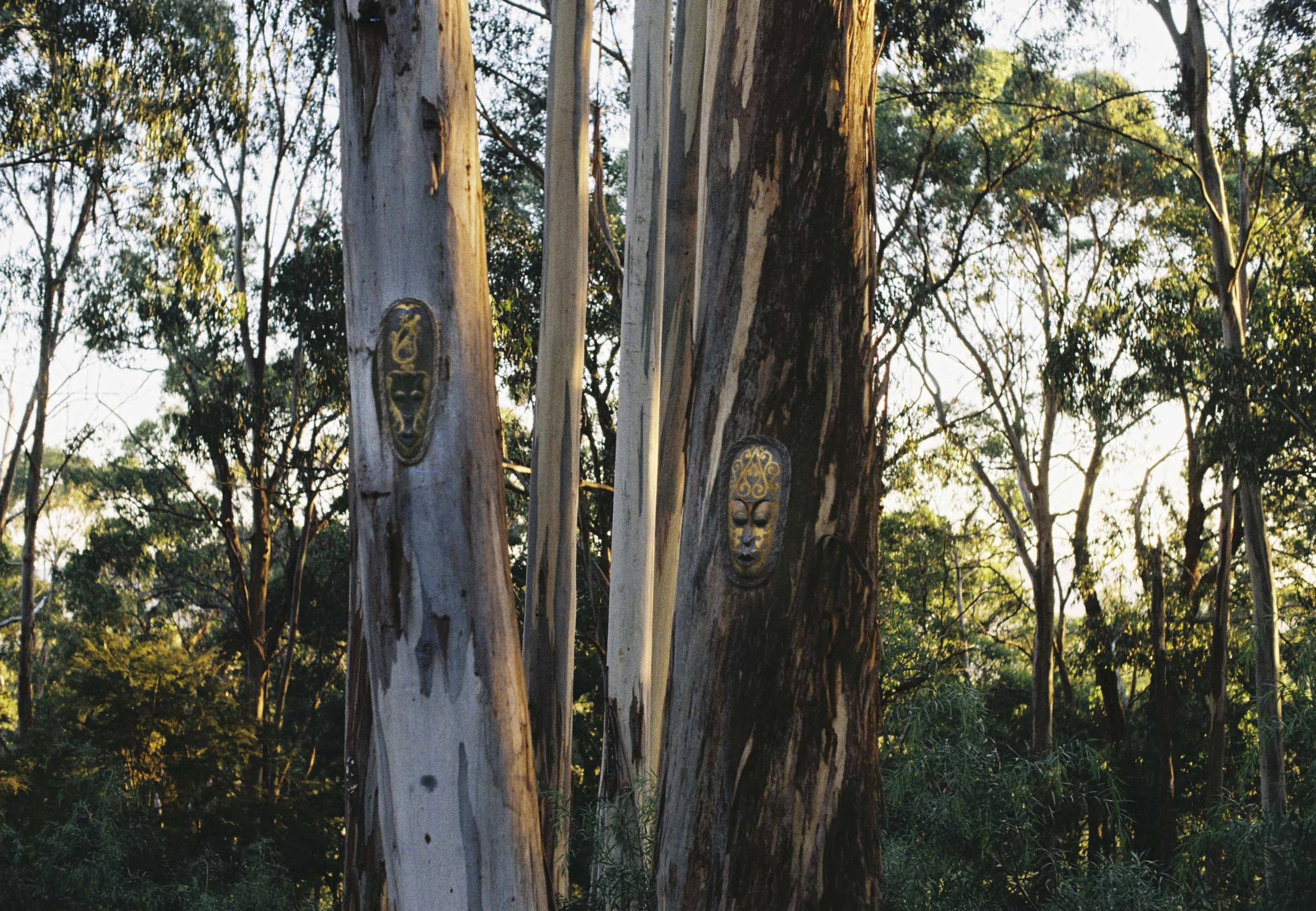
Golden faces in the trees. Forest near Warburton.

The buddha. Sitting still for some time. Not far from the Yarra River.

Sambo, the samber deer. ‘Why am I tied to a tree?’ he says.

Patty K putting the pedal down as we roll across the Yarra Ranges.

Rolling across the Snowy Mountains

The Thredbo River used to be called the Crackenback River. The story went that this was country so steep that it would crack a man’s back if he tried to ride a horse through it.

Pat Kirkby doing his best cowboy pose.

The head of the Crackenback River isn’t far from Mt Kosciouszko. Being the top of Australia, it is fitting that this section of the Great Dividing Range is named the Snowy Mountains. The tallest section of the Snowy Mountains is the Main Range of Mt Kosciouszko and is notorious for the coldest weather and deepest snow in Australia. The scoured alpine plateaus are no place to seek shelter from the wind.

The Alpine Way is a sealed road which connects Kanchoban to Jindabyne and reaches up to 1560m at Dead Horse Gap (the joke is, it was the climb that killed the horse). In sections, tall, orange snow poles mark the edge of the road. If the Alpine Way was not cleared in winter with snow ploughs, no one would be driving on it.

Brumbies abound on the high plains of the Snowy Mountains. There are at least two in this picture. ;)

We recently rode our bicycles from Hobart to Canberra with a good friend of mine, Pat Kirkby. Our journey took us across Tasmania’s Central Plateau, then the Yarra Ranges, the Victorian Alps, then into the Snowy Mountains.  We rode the section from Corryong to Jindabyne in three days, but had a rest day at Tom Groggin due to 40mm of rain, the only day during our 27 day trip where we didn’t ride our bikes at all.

As we rolled into Tom Groggin on day 18 of our trip, I saw a mob of emus close up. As I was riding my bike slowly up a gravel track, the emus kept pace with me walking in front of me. Slowly but surely, I got a bit closer and closer, so I was able to observe their movements for some time. However, there came a decisive moment when I got too close for their comfort and they all bolted. As they ran, they seemed to leave their heads behind while the rest of their body moved forward, a bit like one might expect a cartoon character to behave when startled.

We took our rest day at the lush campsite of Tom Groggin and found that the kangaroos were tame and would come up to us and nudge our hand to give them food. We declined politely. The birds were a bit more cheeky and would steal any food left unattended on our picnic table within seconds. In the end, we spent most of the day inside the tent, listening to sound of rain on the fly. We broke out a pack of cards and played a game called rummy.

The eucalypt forests were lush on the lower slopes of the Snowies.

We struck out the next day to get up the hill to Dead Horse Gap. We were anticipating a steep and grueling climb.The reality did not end up being as difficult as we anticipated, probably because it was day 20 and our bodies were getting pretty conditioned to riding up long steep hills with our fully loaded panniers. We had also figured out that given sufficient snacks, just about any hill becomes possible. Nevertheless, the first pinch of the climb out of Tom Groggin was along a very steep road, perhaps 10 percent gradient for a solid 2-3km. The road was narrow and steep and the traffic included hundreds of motorbikers, camper trailers, semi-trucks but weirdly, no other cycle tourers. Luckily for us, most of the traffic seemed to be heading the other way.

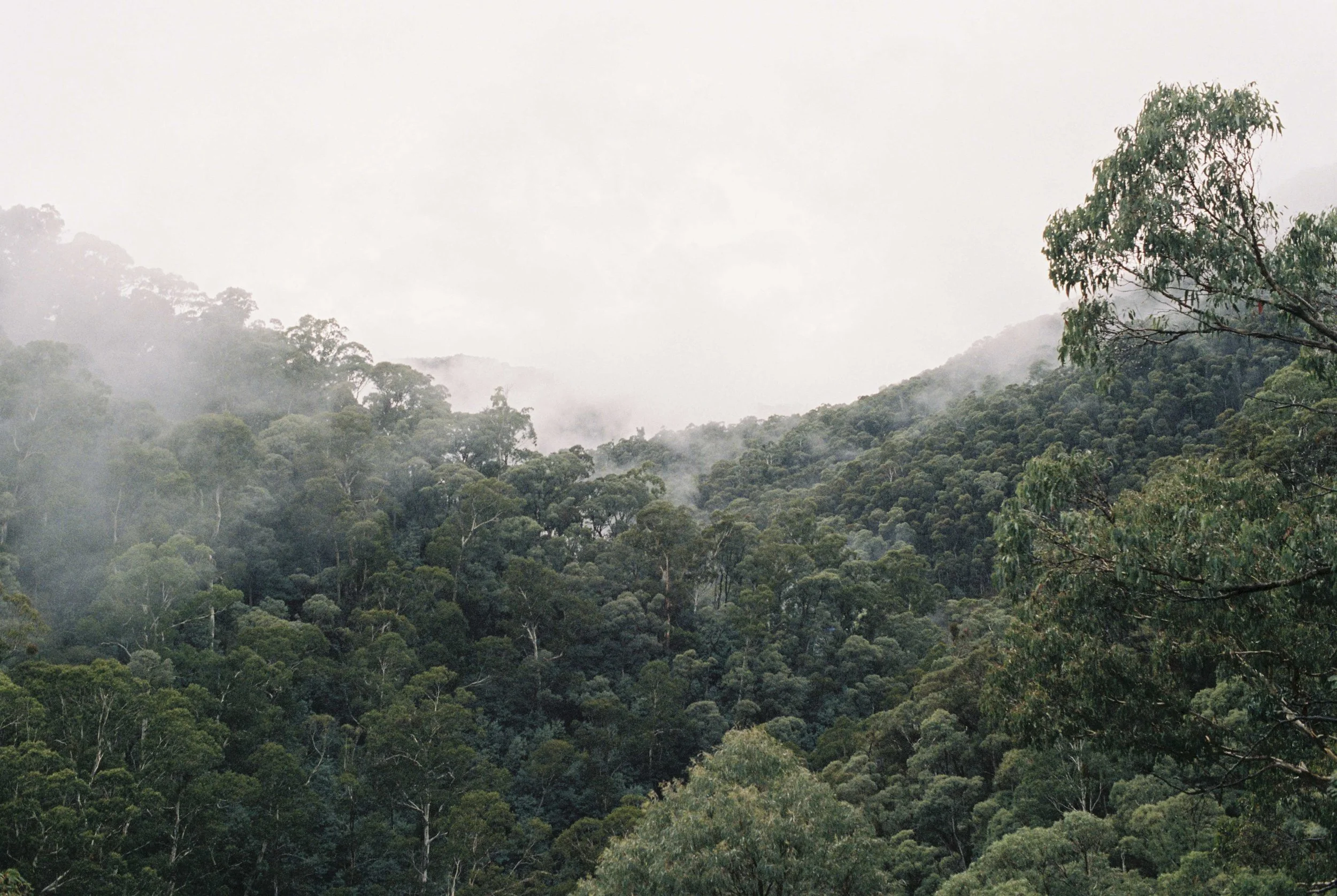
We gained elevation quickly, especially on the first section of the climb as it took us onto the crest of a ridge which continued up to the shoulder of the Rams Head Range. As we climbed, the eucalypt trees got gradually shorter and soon we had climbed into the cloud layer where all was still, damp and cold. The forest around us had been burnt three years ago, and while the damage was extensive, it was also clear that the forest was regenerating, with new seedlings springing up and epicormic growth clearly visible on the trunks of the eucalypts. The mist swirling around us created a haunting atmosphere…

Snowgums burnt in the 2019 fires.

To be continued…

The four directions

If rain doesn’t fall for a long time, we call it a drought.

If rain falls for a long time, we call it a flood.

If there is not enough food, we are having a fast.

If there is too much food, we are having a feast.

If we are too far from the fire, we get cold,

If we are too close to the fire, we get burnt.

If we have enough air, we are breathing,

If we don’t have enough, we are drowning.

-A.S.

South

West

North

East

Was it worth the gambit?

At the end of the trip, I tend to ask:

Was it worth carrying the camera?

Fire scars on top of scrubby ridgeline. 2022, Hasselblad 500C/M, 150mm Carl Zeiss Sonnar 150, Ektar 100.

Of late, I’ve been carrying a medium format film camera on some of my trips. It’s a Swedish camera, made in 1980, a certain Hasselblad 500C/M. It takes very nice photos.

It’s more than 40 years old, and operates impeccably. It has no electronic components, so there is no battery to charge up, or replace. There are twelve shots on a 120mm wide roll of negative film. I tend to shoot one roll of film per trip.

The total weight of the camera kit, including tripod is about 4kgs. So when I head into the hills, and I’m climbing some steep hill with a big pack on, sometimes I wonder about my choice of equipment. Is it really worth carrying all that weight, for 12 shots?

Well, I tend to say to myself that if I take a single good shot, then it was worth carrying the kit. One good shot is all I expect from a trip.

King Billy Pines on scrubby ridgeline. 2022, Hasselblad 500C/M, Carl Zeiss Planar 80, Ektar 100.

It doesn’t always happen, but every now and then, it all lines up and I catch the moment in time.

Herb field, tarns, view toward the crooked spire. 2022, Hasselblad 500 C/M, Carl Zeiss Sonnar 150, Ektar 100.

So, was it worth the gambit?

Into the scrub

“I must not fear. Fear is the mind-killer. Fear is the little death that brings total obliteration. I will face my fear. I will permit it to pass over and through me. And when it has gone past I will turn the eye to see its path. Where the fear has gone there will be nothing. Only I will remain.”

-Frank Herbert, Dune

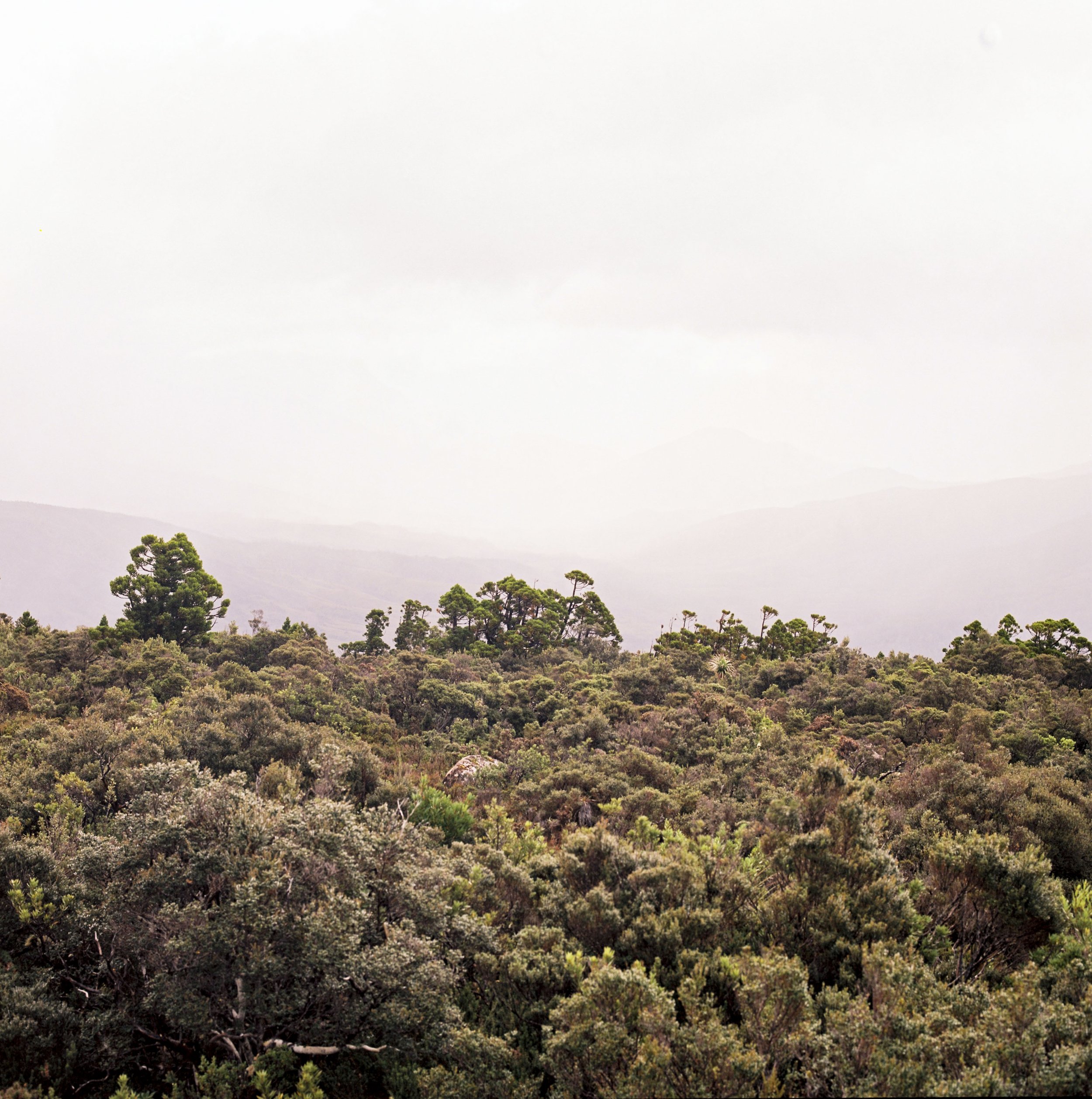
Behold, the South-West scrub!

I used to be scared of the scrub. I feared to enter it on my own, to leave the path and to immerse myself in it. Part of this was rational fear. What if I never find my way out of here? A legitimate concern. Or, will anyone find me if I fall over and hurt myself and I cannot move? (Probably not.)

And so I worked on the steady step. The step that never falters and never falls, it simply keeps going in the correct direction with steady determination. Eventually, the steady step always arrives to its destination. Although the destination is not always what one expected at the outset.

Fagus, above sub-alpine tarn.

The scrub appears to be our adversary. It makes walking difficult, it blocks our way and it requires a lot of effort. It can be painful, exhausting and frustrating to make way, when there are millions of woody limbs sprawled out in all directions, preventing easy progress. But if we spend enough time in scrub, the battle to make progress becomes a dance, one we get accustomed to, and one whose rule we slowly but surely learn.

I would define scrub as low, dense vegetation. Sometimes it might only be waist height, other times, it could be several meters tall. The floor of a forest may be ‘scrubby’, but that’s not really what I would call scrub.

Some of the thickest scrub in Tassie occurs above the forests, in the sub-alpine regions. When the fagus shows up, the myrtle beech trees become dwarfed, and scoparia appears, we know we have reached the dreaded zone. Between the luscious forests and the scoured alpine plateaus, the sub-alpine band awaits with deviousness.
800-1100m in elevation is the Tasmanian ‘death-zone’.

As a friend of mine recently pointed out, ‘The thing about this scrub is that it doesn’t really bend and it doesn’t really break.’ Therefore, progress is rather difficult. In order to get through, one must contort one’s body, and wriggle when stuck. Brute force is pretty much useless as a long term survival strategy. It mainly just wears a person out. Although sometimes, it is required. Especially through bauerea. But steady progress in scrub can only be made by acting like a quoll or a wombat. We must become either very nimble, agile and flexible, or we must get low down to the ground, dig in our teeth, and make a tunnel.

The use of a machette would not only be disrespectful to these hardy sub alpine plants, it would also be mostly useless. More energy would be expended in hacking through thick woody limbs than the amount of effort required to pass through, perhaps snap a few branches by accident and leave a barely noticeable line of weakness.

The best thing about scrub is that at some point, we get out of it.

Bushwalkers tend to funnel into natural bottlenecks on popular walking routes, creating these lines of weakness in the scrub, for subsequent parties to follow. The sad part is, eventually most of these lines of weakness become well worn pads, and some of those pads become well trafficked walkways that offer no resemblance to the original experience. Safe passage becomes matter of fact when there is a clear cut track.

Safe passage through scrub is never guaranteed. Skewered eye balls, broken ribs, heat exhaustion, dehydration, are all very real risks when one spends extended periods of time in the scrub. Progress is painstakingly slow, in some places as little as 1-2km a day, and that’s only through severe effort.

Let the scrub be the scrub. Don’t try to thin it out, order it, tame it, cut it or get rid of it.

Take it or leave it. Just don’t bash it.

Double Exposures

“Just because our efforts are futile, it doesn’t mean they are meaningless.” -A.S.

A sinkhole and a distant ridgeline. 2020, Hasselblad 500C/M, Carl Zeiss Planar 70mm. Ektar 100.

A double exposure happens when the film inside a camera gets exposed to light on two separate occasions, creating two overlapping images on the same piece of film.

In my experience, most of my double exposures have occurred on my Hasselblad 500C/M, and none of them were intended. Since it’s a modular camera, it is possible to wind the shutter up while the film canister is detached. Therefore, it is possible to take a photograph without forwarding the film. Since both photographs are moulded together, it means we didn’t capture the single subject we intended each time. It’s easy to be disappointed, and to feel that both photographs were taken in futility.

King Billy forest and glacial lake. Hasselblad 500C/M, Carl Zeiss Planar 70mm.

But double exposures have their own value and not only because they can help us learn how to use our camera properly.

The result of a double exposure can be a much more interesting image than what we originally intended.

Van on Bruny, tree trunk. Hasselblad 500C/M, Carl Zeiss Planar 70mm.

Raison d'etre

Stand on a mountain

Breathe in as the wild winds blow

Dissolve your shadow.

Curled pandanni leaves

That withstood a thousand storms

Rustle in the wind.

Relinquish the Earth,

Free her from your desire

She will nourish you.

The great mystery

Time, an elastic string

What to do with it?

Old man to the wind

If forest is a city

Mountain is a shrine.

Roaming

There comes a time, when the time comes to get away.

Which way will you go?

Right is wrong and wrong is right

Just follow your heart.

Become lost, then found

It’s coldest just before dawn,

Then the sun rises.

Wind sways through the trees

Dances past the trunks with ease

Rustles fallen leaves.

Tales of ents and elves...

“It's a dangerous business, Frodo, going out your door. You step onto the road, and if you don't keep your feet, there's no knowing where you might be swept off to.”

-Bilbo Baggins from The Lord of the Rings by J.R.R. Tolkiens.

Not exactly a plantation.

There are certain places where we will only ever be visitors.

Deep in the temperate rainforests of Tasmania, it is moist, gloomy and generally cool. The soil smells of decomposing organic matter, and the ground is coated in moss and lichen. This is the prehistoric world of plants; and animal life is rare. Occasionally, a bird will call, but mostly there is silence, except for the whispering leaves in the wind. Warm blooded creatures tend to hang out somewhere else.

Handsome fungi.

This is the world of plants and fungi. When the plants die, when the trees fall down, the intricate network of fungi within the soil go to work, break down the timber, and make these nutrients available for other trees and plants to take up again. And when these fungi are ready to reproduce, we see the mushrooms pop up. But these are only a small part of a much larger organism hidden beneath the ground. The fine filaments of the fungi, or mycelium networks are so numerous that there can be kilometres of these filaments beneath a single footstep.

Two frozen ents, captured in time.

The ents in Tolkiens’ world were the tree protectors, the guardians. They were quite like trees themselves, except they could move. They would talk in really long sentences, because they have seen a lot and they had plenty of time.

I feel that we need more ents in our current time. We need beings who move slow and talk slow, and look out for the trees’ well being. We need elves too, the companions to the human race, except fairer, wiser and with eternal lives. Creatures whose wisdom exceeds ours, and creatures that we could look to, in order to help our own disheveled lives.

Where else would the elves live, but here, among the oldest trees? I haven’t found them yet, but this doesn’t mean that I will stop looking.

A.S. 10/3/22, Lenah Valley.

Fractals in the rainforest.