The first taste of spring

In the temperate and often volatile climate of Tasmania, we tend to farewell winter with a sigh of relief. We feel gratitude as the long hours of darkness shorten and the sun begins to return a little more each day. The winter blues induced by being cooped up, lack of vitamin D and cold fingers and toes can really get to us. So when we see the first blossoms on the deciduous trees in our neighbourhood, we rejoice and celebrate the end of winter.

If one is familiar with the pattern of Tasmania’s climate, one will know that celebrating the end of winter in early September may very well be premature elation. There is a reason that folklore tells us not to plant our tomato seedlings in the garden until show day in late October.

Late winter, including August and September can bring some of the heaviest snowfalls in Tasmania.

Late winter, including August and September can bring some of the heaviest snowfalls in Tasmania.

Having grown up in the northern hemisphere, I always associate September with the falling of leaves and the start of school after the long summer holidays. Here in Tasmania, while September is the official start of spring, it is also one of the most unpredictable in terms of weather, especially in the mountains. It’s the month that brings the transition, and with this comes the wind. If August is the month of deep snow and the bitter end of winter, September is the gusty catalyst that will blow your favourite hat off and take it far away from you. Early spring is a juxtaposition of beautiful, warm, sunny days that promise summer around the corner, followed by torrential rain, and gale force winds. Snowfall is almost guaranteed in alpine areas about a kilometre above sea level, although this is becoming more rare.

The snow simply doesn’t stick around for as long as it used to. Deep snowdrifts in September used to be the norm, now they are the exception. If there is one melancholy thought about the end of winter, it is this; we may very well see snow disappear from Tasmania within a single lifetime.

Warm, sunny days doesn’t mean the ocean is any warmer all of a sudden, but going for a swim does become a lot more tempting.

Warm, sunny days doesn’t mean the ocean is any warmer all of a sudden, but going for a swim does become a lot more tempting.

But let’s talk about spring, for it is upon us. Even if it slaps us across the face with an unexpected thunderstorm, it is so wonderful. It is the beginning of a new cycle, and ‘…at the beginning is balance, at the beginning is essence.’ Spring is an opportunity to start things afresh, to heal old wounds and to refresh our perspectives. It is the time of awakening to our ongoing existence. It is a time to pay attention to our senses, to catch a whiff of those blooming flowers, and to observe nature as she hustles and bustles about. It is a time of productivity, youthful energy and wonderful opportunities.

Go on, stick your nose in it! Smell the flowers! Just don’t get stung by a bee.

Go on, stick your nose in it! Smell the flowers! Just don’t get stung by a bee.

Many households around the world observe the tradition of the ‘spring clean’. Some may dread it, others will embrace it, but unwittingly, most of us practice it in some shape or another. Now is the time to dust off those cobwebs, although not all of them, as the spiders need a home too. Dust accumulates, and if there is ever a good time to rid our houses of it, it is now. It’s time to rethink, to restart and to revitalise. We can’t let a pandemic stop us from appreciating the return of the sun and all its connotations as it brings its influence back into our lives. We must embrace the changing of the seasons and everything that this change brings with it.

What does spring mean for you?

What does spring mean for you?

On a bus going nowhere…

There are times in life when we are stuck in a rut, when no matter how hard we seem to try, winning any progress at all appears overwhelmingly difficult. It might come down to a series of habits which we know are bad for us but we somehow continue to persevere in their daily practice, or we may be surrounded by people who resonate on different wavelengths to us. We may feel depressed at the state of the world, and the impending doom that media channels promise us is coming very, very soon. We feel helpless to change our circumstances and having any positive outlook on life seems ludicrous. We feel stuck on the metaphorical bus going nowhere.

‘The Bus Going Nowhere'‘, 2018. Pentax MX, Triax 400.

‘The Bus Going Nowhere'‘, 2018. Pentax MX, Triax 400.

Now, the first thing that needs to be acknowledged about this scenario is that our situation may not be quite as desperate as it seems at first. While we may not want to be on this stationary bus, there are advantages to staying still for some time. If there is no destination, no outcome, there is no pressure, expectation or urgency. If there is no schedule, we cannot be late. If the bus isn’t moving, it doesn’t need fuel. Instead of rushing through the world, in a desperate hurry to arrive to our next appointment, we can simply remain on this bus, for as long as we wish, and observe the world. We can be the idle flaneur, with nothing better to do than simply take everything in.

After some time however, when we have well and truly convinced ourselves that this bus is definitely not going anywhere, we may be ready to take the next step. This is the realisation that it might be time to get off the bus and start walking somewhere. Anywhere.

‘Pencil Pines in the Walls’, 2019. Pentax MX, Triax 400.

‘Pencil Pines in the Walls’, 2019. Pentax MX, Triax 400.

I have found walking the most reliable way of transport available. So far, it has gotten me exactly where I have needed to go. Every time. Without fail. It may not be a fast way of getting around, but it is very dependable. I recently chatted to someone who walked the Three Capes track, on crutches, with a 28kg pack. He had a great time. Really, he did. Although he may chose to take less weight on his next hike.

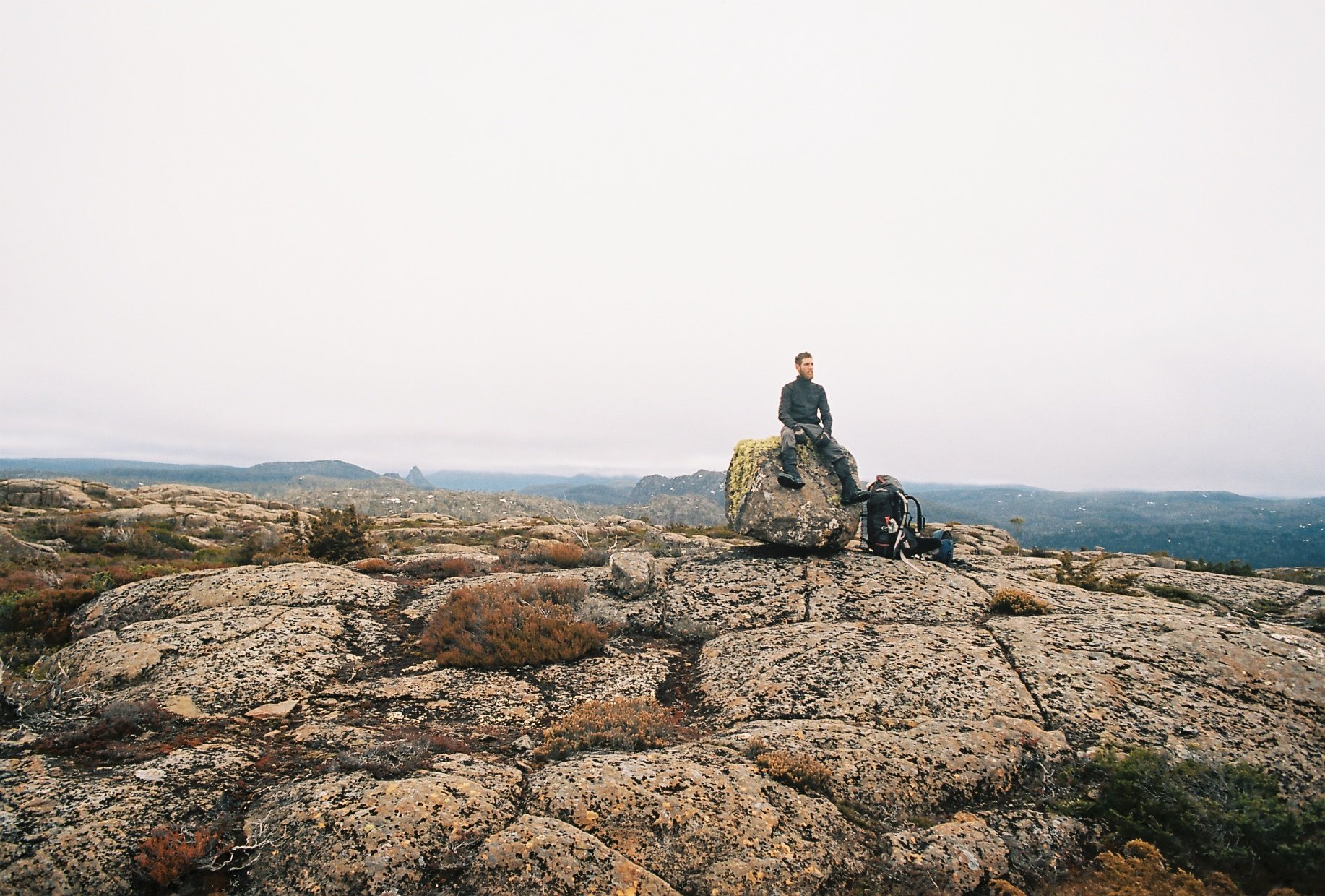
‘The Sermon Seat’, 2018.  Pentax MX, Triax 400.

‘The Sermon Seat’, 2018. Pentax MX, Triax 400.

My point is, even when it is difficult, walking is worthwhile. Part of the reason is that we are allowing the world to come at us at a pace in which we can comfortably process it. Walking gets us where we need to go. And in the process, we are able to observe all the subtle ways in which our surroundings change. They never quite stay the same, even when change is imperceptible.

Glacial valley in the South West, 2018’. Pentax MX, Triax 400.

Glacial valley in the South West, 2018’. Pentax MX, Triax 400.

Welcome back to Mountains of Tasmania!

That’s right, Mountains of Tasmania is making a return! I figured I might as well keep a good thing going. Plus I really miss writing the posts. :)

For those of you that have followed my weekly blog posts throughout 2020 and 2021, thank you!

For newcomers, welcome!

Mountains of Tasmania is my personal blog, where I share analogue photography from the Tasmanian wilderness and stories of trips where not everything went to plan. There is also a healthy amount of philosophical musings and poetry from time to time.

Posts go out early Sunday morning, every week, so please subscribe if you haven’t already. Share with those you think may enjoy the posts and encourage others to subscribe.

Much gratitude.

-Andy Szollosi